


On June 24, the United Countries marks the Global Day of Ladies in International relations.
The instance invitations us to have a good time the sluggish however visual building up of ladies in international ministries, embassies, and world negotiations. But it additionally activates a deeper query: what counts as international relations, and who will get recognised as a diplomatic actor?
That query lies on the center of the Eu funded analysis mission TheoFem which explores the world engagements of Catholic laywomen within the many years following the 2nd International Conflict.
Eleanor Roosevelt retaining a duplicate of the United Countries Common Declaration of Human Rights in Spanish, in November 1949.
Wikimedia
Through having a look past formal diplomatic establishments, the mission unearths how girls and faith formed world debates on social justice, construction, schooling, and peace.
Rethinking international relations past embassies… and past secularity
Once we bring to mind international relations, we typically believe state representatives, formal treaties, and closed rooms. This slender definition has lengthy contributed to ladies’s historic invisibility.
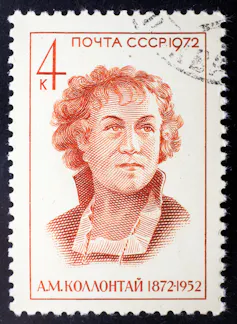
A antique stamp from the Soviet Union of publish WWI Russian girls’s proper’s activist Alexandra Kollontaï led the best way for ladies in international relations. As Russia’s first feminine minister, she helped write many reforms corresponding to the correct to vote, to equivalent pay, abortion, divorce and beginning regulate.
Manuel Esteban / Shutterstock
For a very long time, international relations was once observed as a male area, carefully related to state sovereignty and dominant political cultures, together with male spiritual authority. In contrast background, multilateral diplomatic follow started to increase, first tentatively all through the generation of the League of Countries, after which extra decisively with the introduction of the United Countries, which officially opened diplomatic area to non‑governmental organisations and, by means of extension, to civil‑society actors.
Thus, if we shift our focal point clear of international ministries and in opposition to NGOs and world organisations, an excessively other image emerges. One by which girls have been provide from
the very starting.
Ladies pushed by means of deep spiritual motives regularly fall right into a double blind spot in historical past
Faith has additionally in large part been absent from same old histories of the early United Countries, which regularly provide the organisation as a mundane mission. This omission obscures a very powerful truth: the Chilly Conflict (1947-1991) itself was once, in lots of respects, a non secular war, with ethical, religious, and ideological worldviews shaping world alignments, intelligence paintings, soft-power and construction agendas. This measurement of faith in politics and on a regular basis lifestyles resonates these days with broader debates on faith and democracy.
Ladies pushed by means of deep spiritual motives regularly fall right into a double blind spot in historical past. They seem both too confessional for secular narratives, or they’re silenced, tamed, or misunderstood in reliable spiritual accounts.
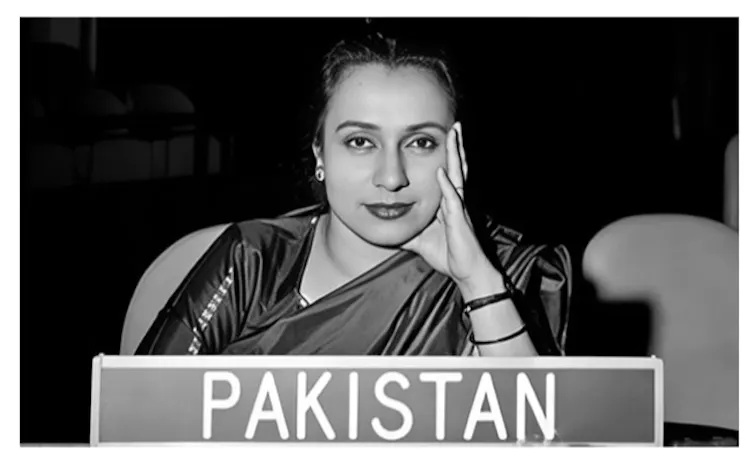
Begum Shaista Suhrawardy Ikramullah, pioneer diplomat, flesh presser and recommend for ladies’s rights she drew on islamic rules to make stronger girls’s rights and international relations.
Wikimedia
Their absence from reliable tales displays each Laurel Thatcher Ulrich’s remark that “well‑behaved women rarely make history” and a phenomenon that Joan Scott has described as sexularism: the idea that the promotion of gender equality belongs simplest to the secular sphere.
Advanced dynamics proceed to form girls’s relationships with faith,
governability and establishments these days, as proven by means of fresh discussions on girls influencing male-led faiths, debates surrounding the Vatican Synod and girls’s participation but additionally the function of indigenous girls and spirituality in international relations.
From the house to the arena at huge
The top of International Conflict II marked a turning level for the development of ladies’s rights and activism. Because the Chilly Conflict intensified and decolonisation complex, societies internationally underwent profound transformations. In Europe, the upward push of welfare states and the reconstruction of social methods created new skilled wishes, in particular in spaces historically, and stereotypically, related to girls: schooling, well being, and social
paintings. On the identical time, as new unbiased or decolonising international locations required trained native elites, together with girls, to fill roles prior to now occupied by means of colonial administrations.
On this context, girls have been increasingly more framed as “experts” in social and ethical problems. Ladies leaders in Global Catholic Organisations, particularly, mobilised a language of provider, accountability, and care that made their public engagement seem each official and vital. They become key intermediaries in those processes: connecting native actors to international debates on construction and justice, whilst additionally collaborating as delegates, observers, professionals, and presidents of world organisations that saved the Vatican knowledgeable on international problems.
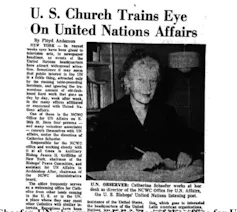
A piece of writing on Catherine Shaefer, UN observer and director of the place of work for UN Affairs.
The Catholic Recommend, Quantity 9, Quantity 42, 13 October 1960.
Wikimedia, CC BY
A gender delicate studying of international relations
Getting better those histories calls for a gendersensitive option to archives and historic silences. Respectable institutional data, whether or not in Vatican, institutional or governmental collections, generally tend to emphasize hierarchy and male management, regularly presenting girls as auxiliary or marginal figures.
Through combining those resources with private papers and correspondence, and by means of studying them ‘against the grain’, we will be able to reconstruct how girls in truth exercised company: how they made choices, constructed networks, and influenced world discussions, significantly all through the Chilly Conflict, when gender become a central fear.
Catholic girls on the beginning of the United Countries
Despite the fact that it should sound unexpected, Catholic laywomen have been some of the earliest non-governmental actors provide on the United Countries’ founding convention in San Francisco in 1945.
One among them was once Catherine Schaefer, who went on, in 1946–1947, to transform the director of the Catholic knowledge place of work on the United Countries in the USA. In Geneva, Jadwiga de Romer headed its Eu counterpart. Different main figures incorporated Christine de Hemptinne, Maria Baers, Françoise de St Maurice, Pia Colini-Lombardi, Marga Klompe, Barbara Ward and Alba Zizzamia.
These kind of girls belonged to, or collaborated with, the International Union of Catholic Ladies’s Organisations (WUCWO), which on the time claimed to constitute 36 million girls international.
WUCWO was once some of the first two Global Catholic Organisations to achieve consultative standing with the UN, together with ECOSOC (1947) and UNESCO (1948), and later UNICEF (1952) and FAO (1953). A long way from being marginal observers, those girls have been embedded within the rising structure of worldwide governance, together with the historical past of the UN Fee at the Standing of Ladies.
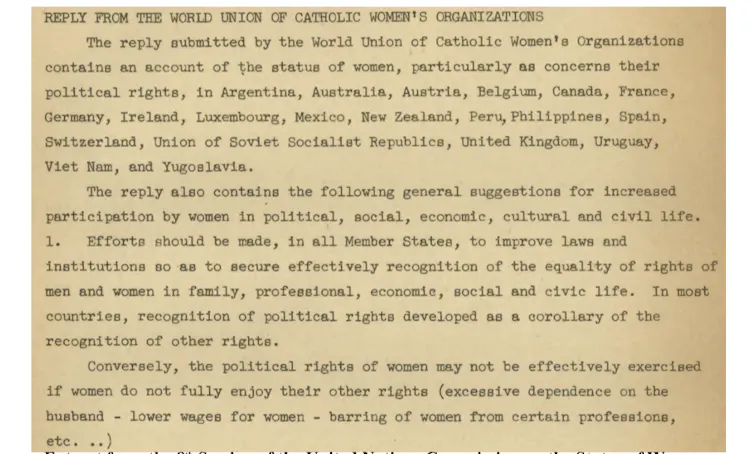
Extract from the eighth Consultation of the United Countries Fee at the Standing of Ladies – Memorandum by means of the Secretary Basic, 3 February 1954.
United Countries Virtual Library machine
Humility as a method
One of the crucial putting findings of the TheoFem mission is that girls’s obvious modesty regularly hid an advanced diplomatic follow.
Many Catholic laywomen followed a rhetoric of humility, obedience, and repair, values strongly promoted by means of Church discourse on the time. They realized to perform inside of decent limits, whilst quietly and successfully pushing the ones barriers outward. There was once regularly an opening between what was once formally accredited and what girls in truth did at the flooring, as they regularly needed to depend on extra pragmatic and advert hoc find out how to advance their agendas. On this sense, faith concurrently strengthened conservative gender norms whilst additionally furnishing ethical vocabularies and institutional areas that girls strategically mobilised to articulate claims for social and gender justice.
Why this historical past issues these days
On an afternoon devoted to ladies in international relations, having a look again issues. First, as it lets in us to recognise lost sight of pioneers. Because the paintings of Patricia Owens has powerfully proven, girls didn’t wait passively to be admitted into world family members, some degree that may be prolonged to the worlds of world organisations and international relations. A very powerful collection of girls who formed world practices have been regularly publicly recognised in their very own time, but many in their contributions have no longer persisted in historic accounts. Revisiting those histories provides us vital gear to query which varieties of diplomatic motion are recognised, valued, and remembered these days.
2nd, having a look again issues as a result of these days’s debates on gender parity, illustration, and inclusion are formed by means of lengthy and numerous histories and lived reports, regularly involving ingenious, oblique, or much less confrontational varieties of resistance. Through acknowledging the diplomatic paintings performed by means of girls (together with the advanced lives of ladies of religion, lengthy and simplistically brushed aside as submissive or apolitical) we will be able to expand our figuring out of international relations itself. This issues the entire extra as girls all over the world proceed to border their engagement and activism in advanced ideological, spiritual and non secular phrases. This standpoint is especially essential when making an allowance for girls within the World South, whose engagement in world family members has regularly been formed by means of religion, spirituality, and ethical authority, and whose varieties of political motion hardly have compatibility secular or state‑centred fashions of international relations.
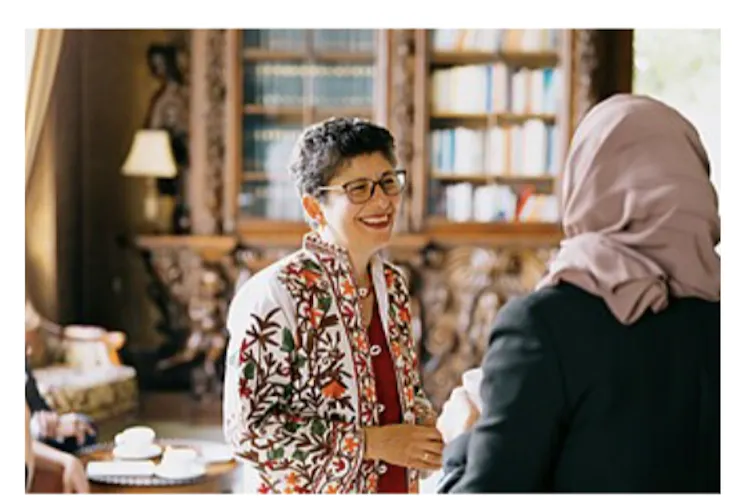
Dr. Azza Karam, former Secretary Basic of Religions for Peace and consultant for the United Countries (2003-2019).
Wiki Commons, CC BY-SA
Re‑analyzing the historical past of international relations and world organisations throughout the lenses of gender and faith is due to this fact crucial, no longer simplest to get well forgotten actors, however to raised know how world politics has in truth been practised.