



Viruses play a big position within the functioning of ecosystems. They profoundly affect the dynamics of microbial communities, glide of topic and international biogeochemical cycles. But regardless of their abundance and ecological significance, a lot of them have lengthy remained invisible to science.
This hole is in large part because of the strategies environmental virologists have used —keeping apart viruses via filtering out higher organisms from herbal samples.
Transmission electron microscopy appearing purified debris of Mimivirus, infecting the amoeba Acanthamoeba castellanii.
(Cynthia Gagné-Thivierge), Creator supplied (no reuse)
This manner used to be efficient for keeping apart maximum viruses we knew about. Till the early 2000s, when an strange virus used to be remoted by accident. As it resembled a microbe, it used to be named mimivirus, for “microbe-mimicking” virus. First of all registered underneath the species identify Acanthamoeba polyphaga mimivirus it used to be renamed Mimivirus bradfordmassiliense in 2024.
This initiated the invention of an entire new crew of “giant” viruses, known as the Nucleocytoviricota. They’re outstanding via their outstanding measurement, very similar to that of small micro organism, and via large DNA genomes that may achieve as much as 2.5 million base pairs, encoding genes from all domain names of existence.
Analysis now finds those viruses — prior to now invisible to so-called conventional virology — as very important to the resilience of utmost polar environments.
Range throughout ecosystems
Massive viruses infect all kinds of microalgae and small zooplankton. They have got profoundly remodeled our working out of the character of viruses, difficult the boundary between the residing and the non-living and the level in their dependence at the hosts they infect.
Some massive viruses raise a part of their very own replication equipment, which permits them to perform maximum in their reproductive cycle throughout the host mobile.
These days, the popular availability of DNA sequencing ways, the status quo of a particular taxonomic framework, and the advance of bioinformatics equipment for detecting those viruses have demonstrated the popular distribution and nice range of big viruses throughout an unlimited choice of ecosystems.
Analysis has proven that they play a big position in microbial functioning and dynamics on a world scale.
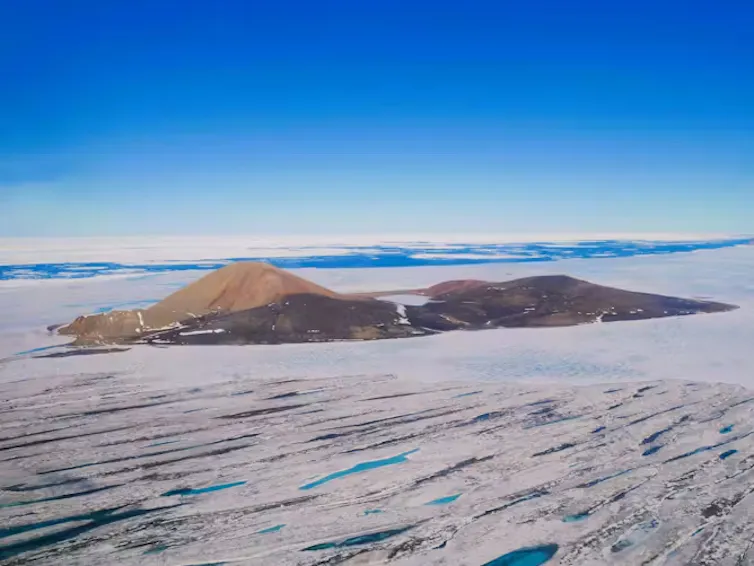
Positioned some 750 kilometres from the geographic North Pole, Ward Hunt Island in Nunavut and its related habitats are house to distinctive massive viruses.
(Thomas M. Pitot), Creator supplied (no reuse)
Viruses as ecosystem engineers
The construction of polar meals webs amplifies the ecological affect of those viruses. Within the aquatic or frozen habitats of the North and South Poles, within the absence of enormous multicellular predators, existence is ruled via single-celled micro-organisms.
Protists and microalgae play central roles right here, however they’re additionally the most popular hosts of big viruses, which take a seat on the most sensible of the meals pyramid.
Those viruses don’t seem to be merely parasites. They act as true biogeochemical engineers by means of two key mechanisms:
The viral shunt: Via inflicting mobile breakdown of their hosts, they free up large quantities of dissolved and particulate natural topic into the surroundings. This procedure feeds vitamins at once again into the microbial cycle, supporting native microbial productiveness within the procedure.
Metabolic reprogramming: Via auxiliary metabolic genes, massive viruses actively modulate their host’s body structure and metabolic job throughout an infection. They seem in a position to optimizing nutrient acquisition, manipulating lipid synthesis to care for membrane fluidity and even influencing their host’s power manufacturing.
Parasites in viral factories
The dominant affect of big viruses on the poles is itself regulated via every other, extra discreet participant: virophages (Lavidaviridae).
Those small viruses can simplest mirror via parasitizing the “viral factories” created via massive viruses (of the Mimiviridae circle of relatives) within inflamed host cells. Via hijacking their sources, virophages cut back the large viruses’ talent to contaminate and in addition to supply virions (the free-floating type of the virus).
This “parasite parasitism” introduces an extra layer of complexity and has main penalties for the stableness of ecosystems. For instance, modelling in accordance with the Natural Lake device in Antarctica displays that the presence of a virophage reduces microalgal mortality. Mockingly, it lets in for extra widespread algal blooms via proscribing the virulence of big viruses — thereby stabilizing the meals internet.

Lake Markham, situated at 83° north throughout the coastal margin, is a polar lake trapped via adjoining glaciers.
(Penelope Blackburn-Desbiens), Creator supplied (no reuse)
Much more unexpected is that positive virophages can combine at once right into a microbial host’s genome and stay dormant till the mobile is inflamed via an enormous virus. They then reactivate to impede viral replication, functioning as a real antiviral defence device.
Those complicated interactions between hosts, massive viruses and virophages are very important to the resilience of utmost environments.
A sanctuary and local weather sentinel
It’s inside this context that positive polar environments, such because the Ultimate Ice Space, grow to be distinctive reservoirs of viral range.
That is the area of the Arctic Ocean this is anticipated to retain its multi-year sea ice for longer than every other area within the North, within the face of present international warming. Positioned alongside the northern coasts of Greenland and the Canadian Arctic Archipelago, it’s characterised via the thickest and oldest ice within the Arctic Ocean and thought to be a long term local weather shelter for ice-dependent organisms.
Alongside the margin of the ultimate closing ice box lies a slim coastal strip comprising freshwater techniques which can be completely lined via ice (epiplatform lakes, ice-dammed lakes, meromictic lakes), fjords, coastal bays and marginal land habitats. Those techniques are secure from alternate via the continual chilly stipulations maintained via the Ultimate Ice Space.
They have got skilled centuries, even millennia, of uninterrupted chilly, minimum hydrological connectivity and excessive geographical isolation. Inside those techniques, the viruses are unfold throughout actual ecological niches dictated via gradients in mild, oxygen and salinity, demonstrating a fine-tuned adaptation to the intense constraints of the Arctic.
This coastal strip provides a herbal laboratory for working out how viruses and their hosts have evolved and advanced underneath solid chilly regimes. It additionally serves as a local weather sentinel: speedy warming on the poles threatens the perennial ice covers and stratified water columns that care for the isolation of its distinctive lakes, in addition to the stableness of the encompassing glaciers.
The breakdown of those bodily obstacles may cause speedy ecological restructuring, a lack of distinctive microbial communities and long-term adjustments within the Top Arctic ecosystems.


