



Underneath our ft lie one of the vital greatest dwelling organisms on Earth. Fungi are most commonly invisible and in large part lost sight of, however they lend a hand maintain the ecosystems and meals methods that we rely on on a daily basis.
In a brand new world find out about, colleagues and I’ve mapped Earth’s huge underground networks of
arbuscular mycorrhizal fungi. Those fungi are invisible to the bare eye and shape partnerships with the roots of maximum land crops. Their hyphae – fungal thread-like filaments – discover soil that roots can not succeed in. This is helping crops gain water and vitamins in trade for carbon mounted by way of the crops thru photosynthesis.
Those mycorrhizal relationships are historic, relationship again greater than 450 million years, and had been almost certainly instrumental in serving to crops colonise land.
This new analysis supplies the primary world estimate of the sheer scale of those underground fungal networks. We discovered that the sector’s topsoils comprise roughly 110 quadrillion kilometres of dwelling fungal filaments. This is nearly one thousand million occasions the gap between the Earth and the Solar.
Mycorrhizal fungi also are primary gamers within the Earth’s carbon cycle. Every yr, arbuscular mycorrhizal fungi channel an estimated 3.12 billion tonnes of CO₂ similar from plant photosynthesis into the soil and jointly comprise round 300 megatonnes of carbon. But regardless of their monumental contribution to ecosystem functioning, they continue to be in large part lost sight of in world checks of biodiversity, carbon garage and ecosystem well being.
Community structure of fungal mycelium. Mycelial structure varies throughout traces and species. Networks imaged on the AMOLF biophysics institute in Amsterdam.
Corentin Bisot – VU Amsterdam, AMOLF Justin Stewart – SPUN
Mapping Earth’s hidden circulatory machine
This world effort was once massively formidable. We accrued knowledge from masses of web sites throughout continents, combining box observations, ecological datasets and modelling approaches to create the primary world estimate of the place arbuscular mycorrhizal fungal networks happen and the way plentiful they may well be.
The findings spotlight how grasslands are a few of the maximum necessary hotspots for underground fungal lifestyles. Prairies, steppes, savannas and wetlands jointly comprise round 40% of the sector’s arbuscular mycorrhizal fungi. One of the vital densest concentrations were present in puts such because the Sudd wetlands of South Sudan, the Florida everglades and the Tibetan plateau.
Scientists provide an explanation for how they’ve mapped underground networks of fungal filaments.
This demanding situations the tendency to focal point nearly solely on bushes and forests when discussing carbon garage and ecosystem conservation and recovery. Grasslands, aided by way of their in depth fungal partnerships, retailer a lot in their carbon under flooring, making them much less prone to disturbances similar to wildfire, drought and hurricane injury.
Why fungal networks subject for farming
The results of the findings lengthen a ways past herbal ecosystems. Arbuscular mycorrhizal fungi act as underground extensions of plant root methods. This makes them doubtlessly vital allies for long term sustainable agriculture.
Alternatively, our find out about discovered that intensively controlled croplands comprise just about part the fungal density present in related herbal ecosystems. Practices similar to in depth tillage, over the top fertiliser use and fungicide software can disrupt or suppress those fungal networks.
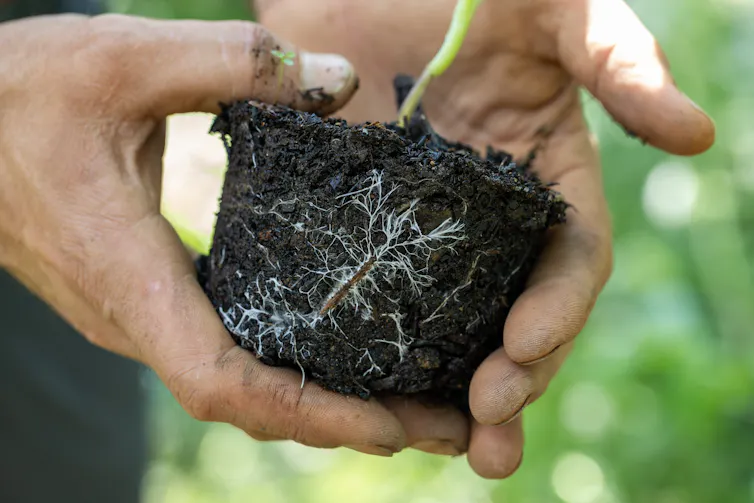
Mycorrhizal fungi are related to the foundation methods of land crops.
marian.galicia/Shutterstock
Coupled with earlier paintings appearing that the similar practices additionally scale back mycorrhizal fungal variety, a troubling image emerges: trendy agricultural intensification is simplifying and diminishing the fungal communities that lend a hand stay soils fertile, vegetation productive and ecosystems resilient.
When fungal communities decline, soils incessantly transform extra depending on exterior inputs. Against this, wholesome, various, fungal networks fortify nutrient biking, improve soil construction, improve plant productiveness and lend a hand them take care of environmental rigidity. Protective and restoring those networks may just subsequently play crucial function in creating extra resilient and sustainable farming methods.
Whilst this analysis marks crucial milestone, it’s also the start of a miles higher medical analysis effort.
Public hobby in underground fungal networks once in a while ends up in claims that they serve as as a “wood wide web”, by which bushes are concept to interchange vitamins, transmit caution alerts and actively assist one every other. However those claims exceed the to be had proof. Whilst fungal networks for sure attach crops and facilitate useful resource trade, scientists are nonetheless running to grasp precisely how those relationships serve as below real-world prerequisites.
Our new find out about supplies a the most important baseline: the primary world map of the place those fungal networks are and what sort of of them exists. To fortify soil well being, fortify meals safety and construct resilience to local weather trade, we wish to pay extra consideration to the life-support machine underneath our ft.


