



Consider residing in the similar wooded area as your folks, grandparents, great-grandparents and your whole ancestors as a long way again in time as tales can inform, and relying at the wooded area for meals, safe haven, sport and training. Consider, then, that the wooded area is determined by you, too, since you and your other folks have secure it for generations.
Then, alongside come govt officers who inform you what you understand: The wooded area is valuable, an environmental and ecological gem that are supposed to be preserved. After which they inform you that to offer protection to it, you all have to go away.
That’s the most recent reason why given in a sequence of efforts to evict the Ogiek other folks, an Indigenous workforce of hunter-gatherers within the Mau wooded area of East Africa. For greater than a century, British colonial government and, later, Kenyan govt officers, have all sought to evict the individuals who have lived there since time immemorial. And in 2017 the Ogieks gained a landmark court docket case earlier than the African Court docket on Human and Peoples’ Rights, which known their prison proper to the land.
However in 2023, Kenya’s govt started evicting them once more, mentioning a brand new justification. The federal government needs to keep the wooded area undisturbed, as a business useful resource in international markets for carbon credit, a gadget through which corporations can declare they’re doing no hurt to the local weather even whilst proceeding to emit greenhouse gases which are elevating international temperatures and converting the local weather. As a substitute, they acquire credit to enhance the absorption from the ambience of an identical quantity of carbon dioxide, similar to via bushes.
This tale continues to be unfolding. And the Ogiek aren’t the one Indigenous workforce experiencing this sort of power in a trend that extends well past Kenya.
The Ogiek other folks search to offer protection to the wooded area that has been their house for hundreds of years and generations.
As nations, corporations and nonprofit organizations world wide search to offer protection to land, keeping valuable environmental assets and decreasing the consequences of local weather trade, the communities in all probability to be displaced are the Indigenous individuals who have lived there for generations.
The Indigenous other folks concerned frequently to find they’re unnoticed of the making plans procedure and feature few prison choices to be had to shield the houses they and their ancestors have cared for over hundreds of years.
I’m a researcher and advisor running on how Indigenous peoples and their land rights are affected, and frequently undermined, via out of doors interventions. I’ve observed that there’s one idea designed to verify Indigenous individuals are integrated in selections about their land. From East Africa to Central Asia, the main exists, however it’s virtually fully unenforceable.
A proper with out enamel
Below the United Countries Declaration at the Rights of Indigenous Peoples followed in 2007, Indigenous communities have a known proper to be meaningfully consulted earlier than anything else is finished to the lands the place they reside. This idea has a reputation: “free, prior and informed consent.”
This proper way Indigenous teams will have to be informed what governments or firms wish to occur on their lands and why, and will have to be given the risk to object or suggest adjustments. And the overall popularity of no matter may occur will have to come voluntarily from the ones Indigenous other folks.
The primary of unfastened, prior and knowledgeable consent was once evolved after a long time of documented hurt to Indigenous other folks via governments and firms that neglected their long-term presence at the land and their standpoint on its use. However this can be a idea, now not an enforceable regulation or law in maximum nations.
So, many governments and firms have interpreted the main loosely, and even dismissed it fully. Regularly they simply inform a couple of representatives of an Indigenous workforce what’s about to occur, sharing key main points too past due for any opposition or revision. That’s what came about to the Ogieks in 2023: The Kenyan govt made up our minds it sought after to keep the wooded area and advised the folks to go away, once more.
Kenyatta Ngusilo, a member of the Ogiek network, salvages what was once left after his storehouse was once burned down via Kenyan police in Sasimwani, within the Mau wooded area.
James Wakibia/SOPA Photographs/LightRocket by means of Getty Photographs
Different selections with out consent
One thing an identical came about within the Arctic between 2008 and 2025. The Arctic Ice Mission, to begin with referred to as ICE911, was once a nonprofit group based to search out techniques to replicate daylight clear of the Earth’s floor and sluggish the melting of Arctic ice. The hassle made up our minds to concentrate on spreading tiny reflective silica microspheres at the ice.
The undertaking was once in the end discontinued on account of issues it will hurt the algae and plankton that shape the bottom of the Arctic meals chain, which sustains each natural world and Indigenous communities within the area. However since its starting, the hassle were adverse via the native Indigenous other folks, who mentioned they have been excluded from discussions.
One Indigenous chief advised me:
“Involvement doesn’t mean … a predetermined intervention, (with the organization) inviting us to a restaurant of their choosing, eating a meal they ordered to discuss our future. … We warned them about the potential impacts, and after all that, they want to hire us as consultants for a predetermined intervention. And they told us to set our price.”
The chief’s level was once easy: What was once being introduced wasn’t consent and significant session. The proposal from the Arctic Ice Mission was once necessarily a charge to log out on a plan that had by no means truly been open to modify or enter from the Indigenous other folks.
A little analysis additionally highlights that community-led conservation initiatives are more practical as a result of Indigenous peoples aren’t relics of the previous, however relatively are energetic, present-day stewards with dynamic and complicated wisdom methods rooted of their courting with their land.
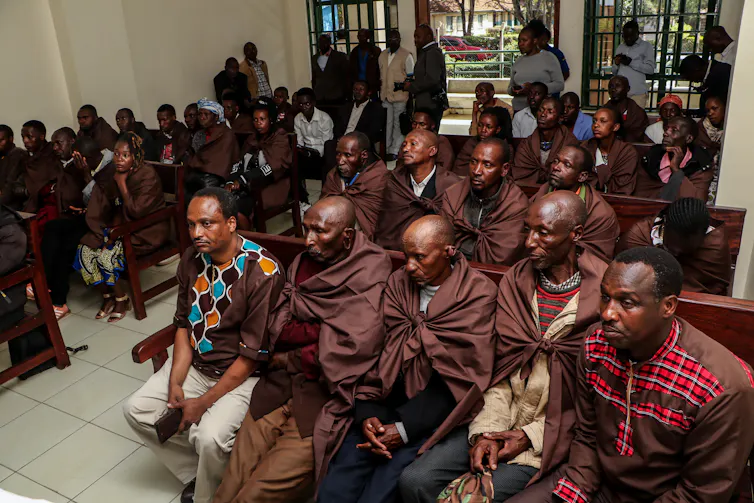
The Ogiek network has fought in courts for his or her rights over a few years.
James Wakibia/SOPA Photographs/LightRocket by means of Getty Photographs
Competing pursuits
What connects those instances isn’t malice. Governments, firms and nongovernmental organizations all perform in aggressive environments the place monetary pressures and insufficient rules can push social and environmental issues to the margins. That suggests the folks with probably the most direct courting to the land are frequently the final to be consulted about what occurs to it.
The primary of unfastened, prior and knowledgeable consent was once designed in particular to wreck that trend. However so long as it stays a idea relatively than an enforceable legal responsibility, I concern that significant session will proceed to get replaced via the semblance of it, within the type of a gathering that’s held too past due, a report signed via the mistaken other folks, or a consulting charge introduced to approve a call that had already been made.
Some nations have ratified the World Labour Group’s Indigenous and Tribal Peoples Conference, agreed in 1989, which accommodates this idea. Some nations, together with the Philippines, Colombia and Peru, come with the main of their nationwide rules. However different nations have now not made so formal a dedication, and nonetheless others, together with the U.S., have now not ratified the world settlement within the first position.
In my opinion, now not till the communities it was once designed to offer protection to are introduced in in the beginning, as decision-makers with veto energy, will the main reach its purpose.

