



The panorama at the far flung Isle of Lewis is hanging: a mixture of rugged terrain, peatlands, moorlands, lochs, sandy seashores and cliffs.
This island on the northern finish of the Outer Hebrides, Scotland, has one of the vital UK’s perfect ranges of gasoline poverty and a declining inhabitants of fewer than 20,000 other people. Encircled by way of the Atlantic and uncovered to robust, chronic winds, it is a perfect location for wind power.
The Galson Property, a gaggle of twenty-two villages protecting 56,000 acres within the north-west nook of the island, recognised this possible early on. It transitioned to network possession in 2007 by way of forming a network land agree with. Between 2013 and 2015, the agree with put in 3 wind generators. The income from renewable power era may then be reinvested within the property.
Over a decade, those property generated £4.35 million in surpluses for the network land agree with. Of this, £600,000 has been used to strengthen native initiatives thru grants (with the rest used for operational prices). This contains tasks that alleviate poverty, inspire environmental stewardship and cultural heritage plus the sustainable construction of this native financial system.
However our ongoing analysis at the island presentations that the way forward for community-owned power is in danger. Those initiatives are going through chronic boundaries to grid get admission to. They come with restricted capability of the interconnector (a subsea cable linking Lewis to the mainland grid), along an utility procedure that favours large-scale initiatives and growing older generators.
As Neil MacKinnon, construction supervisor on the Galson Property Consider, informed us: “Out of the interconnector cable’s 1.8 gigawatts, about 1.4 are for offshore wind, and the rest for onshore wind. Communities have been completely ignored and squeezed out of this.”
Galson Property Consider runs this power undertaking of the Isle of Lewis.
Laure Leglise, CC BY-NC-ND
Group possession of wind farms on Lewis delivers actual effects. Believe the Level and Sandwick Consider’s three-turbine 9 megawatt undertaking – the most important community-owned windfarm in the United Kingdom. This generates 34 occasions extra income than what the locals would obtain in network get advantages fee if an organization owned the generators.
However in spite of those confirmed social and financial contributions, many generators around the Scottish Isles are drawing near the tip in their operational lifespan, which is round twenty years. These kinds of initiatives began 15 years in the past, when supportive executive insurance policies empowered native other people to increase their very own windfarms and reinvest income without delay in island economies.
There’s now an pressing want to repower growing older, first-generation wind generators by way of changing them with extra environment friendly fashions. However new infrastructure making plans is ignoring community-owned initiatives and making it tougher for native citizens to learn.
In 2022, power regulator Ofgem licensed a brand new Western Isles interconnector cable to extend electrical energy transmission capability between Lewis and the mainland.
However to be had cable capability used to be hastily allotted to huge company power builders, particularly for offshore wind. Group-owned tasks had been left with out the grid get admission to had to increase era or make a industry case for changing growing older generators.
Group-owned organisations on Lewis, together with Level and Sandwick Consider and the consortium shaped by way of the Galson, Barvas and Carloway Property Trusts are all suffering to safe capability at the interconnector.
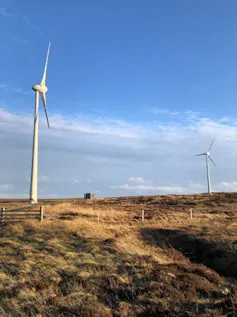
Two generators owned by way of the Galson Property Consider.
Laure Leglise, CC BY-NC-ND
Those aren’t remoted examples of initiatives going through demanding situations with grid connection.
Within reach, at the islands of Tiree and Islay, community-owned trusts have became to sun, which generate much less power and due to this fact income, relatively than new generators because of grid constraints. Throughout the United Kingdom, greater than 600 network power organisations face equivalent issues.
A lot of the transmission capability required to ship the United Kingdom executive’s Blank Energy 2030 Motion Plan has already been allotted inside the connections queue. This leaves restricted scope for brand spanking new or repowered network initiatives. This problem is especially acute for locally-led tasks, which, not like company builders, are inherently place-based: they can not merely relocate to areas with spare grid capability.
Grid connections reform replaces the first-come, first-served way with a gadget that prioritises initiatives which can be maximum complex and commercially viable. This calls for builders to show important development and pay in advance prices at previous phases.
For network initiatives, this monetary chance may threaten their survival. Particularly because the connections reform pushes citizens in opposition to greater, extra capital-intensive tendencies merely to compete inside the connections queue.
Those adjustments chance except for community-led tasks from the transition, undermining each its equity and its possible to ship domestically disbursed financial and social advantages.
A proper to infrastructure get admission to
Whilst our ongoing analysis has exposed demanding situations going through community-owned power initiatives, hope isn’t misplaced. Development on Scotland’s pioneering legislative empowerment of communities, we recommend a “right to infrastructure access” with 3 priorities for Scottish and UK governments.
First, a manufacturer class attention in pricing auctions: the Nationwide Power Device Operator does no longer recently differentiate between candidates at the foundation of possession fashion or social worth. With out political intervention to create a brand new class to differentiate between community-owned and company initiatives, the present gadget will proceed to favour extensive firms that may have the funds for to tackle dangerous initiatives.
2d, the above calls for a proper definition of network power initiatives inside grid allocation and pricing methods. This sort of definition is important no longer best to verify focused strengthen, but in addition to forestall power firms from exploiting community-oriented insurance policies thru superficial partnership preparations.
Group power must be outlined in keeping with transparent standards with regards to possession, governance and get advantages distribution. On the very least, initiatives must show majority native possession (akin to by way of trusts), democratic decision-making buildings and a legally binding dedication to reinvest income into network – relatively than personal shareholder go back.
In the end, making plans for the end-of-life segment of the generators will have to additionally transform a core a part of network power coverage. With out mechanisms that safeguard substitute capability for established schemes, native teams may in the end lose get admission to to the very infrastructure on which their financial and social futures rely.
Those 3 steps will lend a hand make certain communities like the ones at the Isle of Lewis can proceed to take part without delay within the inexperienced transition. With out this dedication to social justice, a renewable power long run will best irritate inequalities and throw native possession to the wind.