



Sedimentary basins – depressions in Earth’s crust led to by way of tectonic exercise – have a tendency to be flat and are favoured puts to construct towns. However all over earthquakes, they may be able to develop into herbal resonance chambers.
Identical to sound waves echoing round an empty corridor, this implies seismic waves can get trapped in those basins and leap backward and forward to create “seismic echoes”.
Relying at the form and intensity of the basin, those echoes can develop into amplified and be extremely damaging.
Seismic waves can get trapped and leap backward and forward.
Writer equipped, CC BY-SA
New Zealand’s capital town Wellington is constructed on a sedimentary basin and is an instance of this phenomenon.
Within the 2016 magnitude 7.8 Kaikōura earthquake, Wellington’s central industry district skilled shaking that exceeded design predictions. Despite the fact that the quake was once situated 80 kilometres from the town, it led to serious injury to infrastructure, with many multi-storey structures broken or destroyed.
Archival information additionally display that all over the 1942 magnitude 7.3 Wairarapa quake, which was once situated about 80 kilometres north of Wellington, some 10,000 chimneys have been destroyed within the town.
Our new analysis supplies an up to date style for the central Wellington basin.
We discovered it’s virtually two times as deep (about 500 metres) than in the past concept and that its form is considerably other from the former style. Those variations pass a way towards explaining why the shaking was once more potent than anticipated.
The deadliest instance from historical past
Traditionally, essentially the most devastating instance of seismic echoes, or trapped waves, was once the 1985 Mexico Town earthquake, which killed 8,000 other folks and destroyed high-rise structures.
The quake’s epicentre was once 350 kilometres west of the town, but if waves of average amplitude arrived within the town, they changed into trapped within the low-wave-speed sediments of the basin on which it’s constructed and changed into amplified.
Because the waves bounced backward and forward, they created a status wave, very similar to water waves in a bathtub.
Because of this, the town skilled particular slim zones of utmost destruction, underscoring the danger from even very far away earthquakes for towns constructed on sedimentary basins.
Seismic echo chambers
Seismic waves develop into trapped and amplified for 2 major causes.
First, because the waves transfer from a quick wave-speed medium (cast basement rocks) to the low wave-speed of sedimentary rocks, the amplitude of the waves will building up to make amends for the drop in wave pace.
That is very similar to a tsunami wave that travels around the deep ocean with a small amplitude however excessive pace, after which, because it comes nearer to shore in shallow water, slows down however dramatically will increase in amplitude.
This interchange between wave amplitude and pace is to do with the power of the waves, which should stay consistent.
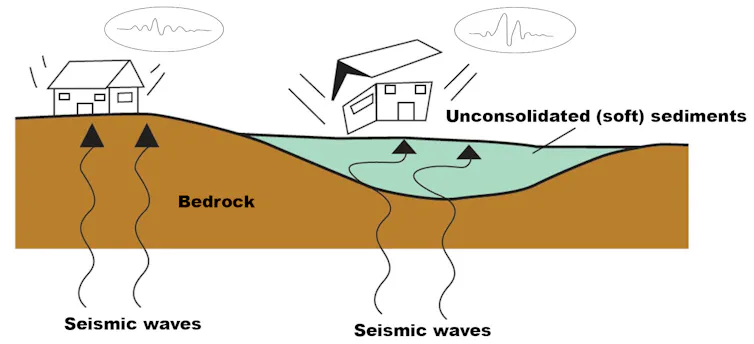
As seismic waves trip from extra cast basement rocks to sedimentary rocks, their amplitude will building up to make amends for the drop in wave pace.
Writer equipped, CC BY-SA
The second one explanation why for the amplification of seismic waves in a basin is resonance – when the wavelengths of the incoming seismic waves are very similar to both the vertical and horizontal dimensions of the basin.
If the basin has steep aspects, an edge impact could also be generated the place sturdy amplification can happen on the subject of the brink of the basin because of a buildup of various wave sorts.
Most likely essentially the most unexpected of our findings is the form of the basin underneath Wellington. Its efficient western edge isn’t the Wellington Fault, as in the past assumed.
As a substitute, the brink cuts around the basin at a excessive perspective to the Wellington fault and follows the road of 2 in the past recognized, low-activity faults – the Terrace and Lambton faults.
Those variations between the brand new and outdated basin fashions have important affects at the predicted shaking Wellington would possibly be expecting. Particularly, there can be an impact connected to the newly described edge, and the anticipated amplification can be upper for a deeper basin.
We used a three-D style of the basin in a pc simulation for the shaking at frequencies of 0.7 Hertz (the dominant shaking frequency recorded all over previous quakes). We discovered that the amplifications of horizontal floor movement might be 2.5-Thrice the background stage adjoining to the western fringe of the basin.
Once we in comparison this predicted trend of amplified shaking to the place the real broken structures have been situated all over the Kaikōura earthquake, we seen some correlation with the western fringe of the basin.
On the other hand, we want to be wary when making this comparability as this trend might be connected to different components, such because the distribution of reclaimed land and clustering of inadequately designed structures.
Our find out about however highlights two key issues.
First, easy geophysical strategies can now be utilized in city spaces to map out the intensity and form of basins that towns are constructed on. From those fashions, we will then generate pc simulations to expect the positioning of amplified shaking.
This will likely result in extra granular zoning for what portions of towns could also be extra inclined.
The second one key level is upper consciousness of the danger to towns constructed on sedimentary basins from no longer most effective native, but additionally far away earthquakes.


