



The efficient cave in of the Long run Battle Air Machine (FCAS) fighter jet programme is a significant setback for Eu defence cooperation.
France, Germany and Spain have spent just about a decade seeking to broaden what was once
supposed to grow to be Europe’s premier next-generation fight airplane, just for the
programme to succumb to disputes over management, the distribution of labor and highbrow belongings.
But Europeans shouldn’t be stunned. The historical past of Eu fight aviation is plagued by programmes that struggled below the burden of competing nationwide ambitions. On this recognize, FCAS seems to be much less like an unusual failure than the most recent bankruptcy in a routine tale.
The extra essential query isn’t why FCAS has run into bother, however fairly what its cave in finds about Europe’s talent to generate and maintain the army features it’s going to want in a extra bad global.
Adversaries at the moment are making an investment closely in built-in and layered air defences encompassing long-range missiles, digital war features and increasingly more refined sensors. Keeping up the power to penetrate defended airspace in long term conflicts would require a step exchange in capacity.
FCAS was once conceived as a “sixth-generation” fight device – the most recent jump in fighter jet generation – to triumph over this contested air atmosphere. At its centre would sit down a brand new fight airplane, supported by way of self sustaining drones, complicated sensors, digital war programs and a virtual community linking the whole lot in combination from the 2040s.
The problem is that such programmes are changing into extremely pricey to broaden. Through sharing prices, experience and commercial capability, Eu governments hope to succeed in features that might differently be past their achieve.
The Eurofighter Storm was once one of the vital a hit army collaborations of the chilly struggle.
R. Sanchez Aviation Photograph / Shutterstock
Fact test
In spite of the perceived commonalities, the FCAS international locations – France and Germany in
specific – had very other targets.
For France, the challenge was once by no means merely about changing its Rafale fighter jet. Any successor airplane would sooner or later must reinforce the airborne element of France’s nuclear deterrent, function from its airplane provider, and keep sovereign commercial features – in particular the power to independently design and construct complicated fight airplane. The insistence by way of France on design management for FCAS due to this fact mirrored considerations about nationwide autonomy, even supposing portrayed as commercial obstinacy.
In the meantime Germany, represented by way of the aerospace massive Airbus, had no real interest in financing a programme that was once most likely to pay attention Europe’s most precious experience, highbrow belongings and design authority in Dassault, the French aerospace corporate, for many years to return.
Those tensions are rarely new. Within the Nineteen Sixties, Britain and France tried to construct the Anglo-French Variable Geometry airplane. However France’s withdrawal in 1967, for equivalent causes to FCAS, resulted in the challenge’s cave in.
Different joint Eu initiatives have succeeded. For example, the Panavia Twister. And within the Nineteen Eighties, the Eurofighter consortium was once advanced. This time, regardless of France taking flight (to supply the Rafale), the United Kingdom, Germany and Italy proceeded (with Spain later becoming a member of) with what would grow to be the Eurofighter Storm.
Reliance on The usa
For many years, due to this fact, Eu collaborative programmes were anticipated to do a number of issues directly: ship army capacity and maintain nationwide industries whilst strengthening diplomatic relationships or no less than no longer provoking them.
That can were a manageable compromise when Europe’s safety was once underwritten by way of the USA and the risk from Russian seemed contained. It’s a long way more difficult to justify when Eu governments are caution that the continent will have to rearm.
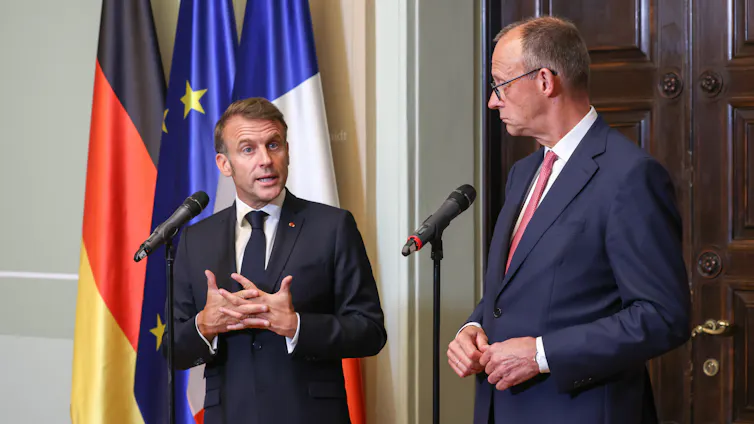
Emmanuel Macron and Friedrich Merz have a number of choices within the wake of the challenge’s cave in.
EUS-Nachrichten
The problem is compounded by way of the converting courting between governments and
business. In contrast to Airbus, which stays in part state-owned, Dassault is managed by way of the circle of relatives that bears its identify.
This displays a broader pattern of Eu governments frequently exercising much less affect over primary defence corporations than they did all over the chilly struggle, when state possession and bigger commercial festival gave them extra leverage. That is to mention not anything of the tech corporations increasingly more basic to army capacity.
That issues as a result of defense force are constructed over many years, no longer electoral cycles. If Eu governments battle to mobilise business to satisfy their defence necessities, they will to find themselves confronting capacity gaps at exactly the instant they’re seeking to deter aggression.
Germany’s defence minister, Boris Pistorious, has already defined 3 possible choices to FCAS. The primary and most straightforward is to shop for extra F-35s from the United States. However this is able to fall in need of Germany’s necessities whilst additionally deepening dependence on the United States – one thing Eu international locations are willing to keep away from.
The second one possibility is to sign up for every other collaboration, perhaps the UK-Italian-Jap effort to construct a sixth-generation fighter, known as the World Battle Air Programme (GCAP). Germany’s rising defence funds may just give you the challenge with further investment and a bigger order e book. However it might additionally lift questions on affect.
But when Berlin rejected a subordinate function inside FCAS, it’s not likely to simply accept one inside GCAP. Present companions might due to this fact conclude that the advantages of growth are outweighed by way of the hazards of prolong to a programme concentrated on access into provider by way of 2035.
The 3rd possibility is a German-led effort, being mentioned throughout the proposed Staff Gen 6 commercial grouping – an Airbus-led alliance of 8 defence corporations. This might remedy business considerations, keep German design ambitions and would possibly permit Berlin to construct a coalition with different companions, comparable to Spain and Sweden.
Nevertheless it might be prohibitively pricey, dangerous, and by way of additional fragmenting Europe’s already crowded fight airplane panorama, scale back the viability of the entire current programmes. France faces in a similar fashion tricky alternatives. It may pursue a countrywide successor to Rafale, conserving keep watch over over commercial, nuclear and provider necessities however accepting really extensive prices. Or it would search a revised collaborative framework.
Each French president Emmanuel
Macron and Germany’s chancellor Friedrich Merz have made transparent that different alternatives for collaboration exist, such because the drones supposed to reinforce the FCAS fighter jet, or the primary airplane’s engine.
The revel in of FCAS isn’t that Europe can not cooperate. Historical past displays differently, and GCAP might once more reveal {that a} pragmatic coalition can prevail the place a extra politically formidable partnership failed.
What FCAS does expose, on the other hand, is a rising mismatch between Europe’s safety
atmosphere, how it continues to obtain defence apparatus and the prices concerned. The new resignation of Britain’s defence secretary, John Healey, amid disputes over defence investment, issues to the similar drawback.
Eu governments increasingly more agree at the threats they face, however stay “unwilling” to make the monetary and political compromises required to deal with them. That are meant to worry us all.

