






June 17, 1969. Distinguished left-wing German political thinker Herbert Marcuse is handing over a lecture on the Teatro Eliseo in Rome. Marcuse is in mid-flow when any person within the target audience interrupts him:
Herbert, let us know why are you getting paid by way of the CIA?
The heckler used to be Daniel Cohn-Bendit, one of the vital high-profile figures related to the coed motion of the Nineteen Sixties and the New Left – a political and cultural tendency with which Marcuse himself used to be related.
Marcuse’s answer suggests this used to be no longer the primary time such an allegation were levelled in opposition to him. “I have been accused of being paid,” he snapped, “by the Kremlin, by Beijing, by capitalism, by Wall Street.”
The Cultural Marxism Conspiracy: Why the Proper Blames the Frankfurt Faculty for the Decline of the West – A.J.A. Woods (Verso)
Those quotes come from Gabriel Rockhill’s Who Paid the Pipers of Western Marxism? Printed in 2025, the e-book brought about a stir in leftist circles. Rockhill argued that, all through the Chilly Conflict, the CIA and a community of allied foundations and cultural organisations covertly sought to form the path of left-wing concept within the West.
The purpose, he claimed, used to be no longer merely to struggle Soviet affect, however to inspire kinds of dissent that gave the impression radically important of the prevailing order, whilst in the end last suitable with the wider political and financial priorities of the Western capitalist order.
Consistent with Rockhill, the postwar intelligentsia changed into entangled in those webs in numerous tactics, some knowingly, others unwittingly. The outcome used to be a model of Western Marxism that privileged cultural critique and indifferent mirrored image over modern politics and organised magnificence battle.
That is the place Marcuse enters the body. Marcuse used to be a member of the Frankfurt Faculty, a band of German-Jewish intellectuals related to the Institute for Social Analysis. Based in Frankfurt in 1923, the institute introduced in combination thinkers reminiscent of Theodor Adorno, Erich Fromm, Max Horkheimer and, later, Marcuse. They sought after to grasp why the revolution predicted by way of Marx had didn’t materialise within the complicated capitalist societies of the West.
As Stuart Jeffries notes in Grand Resort Abyss (2016), his highbrow biography of the crowd, what prominent the Frankfurt Faculty used to be the best way its individuals drew on psychoanalysis and philosophy to give an explanation for why capitalism had proved way more sturdy than many Marxists had anticipated. Additionally they
engaged with the upward thrust of what they referred to as the tradition business and thereby explored a brand new dating between tradition and politics, the place the previous served as a lackey of capitalism and but had the prospective, most commonly unrealised, to be its gravedigger.
On this model, the Frankfurt Faculty helped redirect Marxist inquiry against questions that lay past the manufacturing facility flooring and the sector of formal politics.
Jeffries makes the purpose that the Frankfurt Faculty used to be continuously higher at figuring out the issues of recent capitalism than the energies in a position to overcoming them. Adorno, for one, remained deeply sceptical of scholar activism, at the same time as many scholars embraced his critique of capitalist society.
Marcuse took a unique view. He noticed within the scholar protests the potential for a brand new form of political resistance rising past the bastions of the standard business operating magnificence, upon whom Marx and his inheritors had as soon as pinned such excessive hopes.
Nonetheless, Rockhill is right kind to id a shift in emphasis. The Frankfurt Faculty modified the theoretical terrain on which many next Marxists would perform. Questions of tradition and awareness assumed a prominence that they had no longer in the past loved, reshaping the priorities of educational Marxist inquiry for many years to return.
Whether or not this enriched the Marxist custom or diluted its radical drive stays an open query.
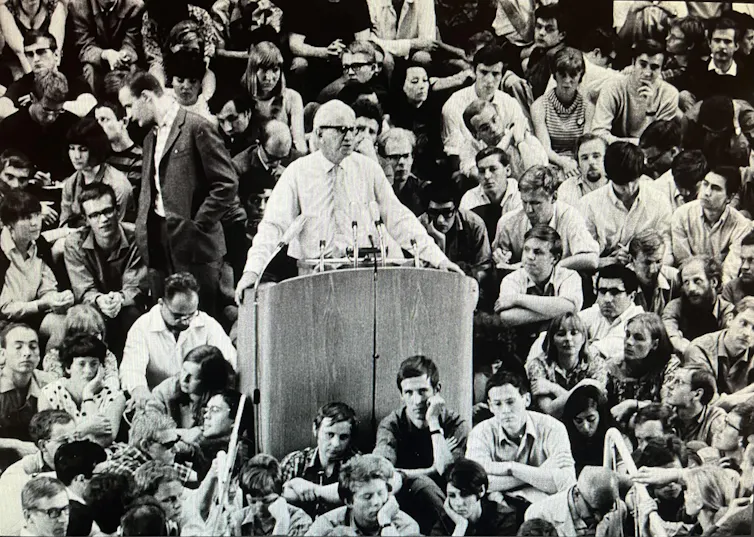
Herbert Marcuse giving a lecture in Berlin, 1967.
Isaactrius, by means of Wikimedia Commons, CC BY-SA
Inventing ‘cultural’ Marxism
That is value maintaining in thoughts as we flip to highbrow historian A.J.A. Woods’ very good e-book The Cultural Marxism Conspiracy: Why the Proper Blames the Frankfurt Faculty for the Decline of the West. Woods’ research, like Rockhill’s, is grounded within the customs of ancient materialism, drawing specifically at the paintings of the Italian Marxist Antonio Gramsci.
The tale Woods tells, then again, could be very other. In December 2021, Woods writes, the time period “cultural Marxism” used to be added to the Oxford English Dictionary. If the OED access used to be anything else to move by way of, it used to be an expression “with a sinister and controversial past”.
It may be traced again to the Nineteen Thirties. It made an early look in a newsletter related to British fascism. But for far of its historical past, the word languished in relative obscurity.
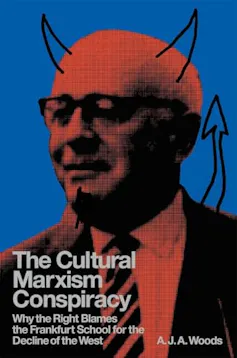
No longer so now. Cultural Marxism – every now and then known as the “Cultural Marxism conspiracy theory” – has turn into a staple of modern right-wing discourse. In the USA, politicians, together with Pete Hegseth and Ted Cruz, have hired the time period to give an explanation for social adjustments they regard as destructive or destabilising. An identical claims were made in Latin The us, the place leaders like Javier Milei and Jair Bolsonaro have warned of what they regard as its pernicious affect.
The idea holds that the Frankfurt Faculty, having concluded that capitalism used to be not going to cave in underneath the load of its personal contradictions any time quickly, evolved a brand new technique for communist subversion whilst dwelling in The us throughout the Nineteen Thirties and Nineteen Forties, having fled from Nazi Germany in concern in their lives.
On this telling, as Woods observes, “the Frankfurt School and their devotees are blessed with a magical level of agency that can overcome all contradictions and countervailing forces”.
The argument, in a nutshell, is that Adorno and his nefarious associates strove to undermine Western society from inside, regularly infiltrating college campuses and corrupting impressionable younger minds. Different key establishments would apply. Without equal purpose used to be to perpetually upend the cultural foundations of recent existence.
Narrative of decline
The idea has confirmed remarkably sturdy. Woods notes that it’s been used to account for tendencies as numerous as feminism, political correctness, the rising visibility of LGBTQ+ communities and, extra just lately, actions reminiscent of Black Lives Topic and efforts to handle local weather exchange.
The Cultural Marxism Conspiracy, Woods emphasises, isn’t a ancient account of the Frankfurt Faculty, in step with se. Its worry isn’t the origins of a coterie of German intellectuals, however the ancient prerequisites that made a conspiracy idea about them conceivable. Neither is the e-book an try to debunk the sprawling idea that has grown up round it.
As a substitute, as Woods put it, the quantity seeks
to determine a sequence of important puzzles. Why does this narrative of cultural degeneration focal point such a lot on a collective of German Marxists? How does it proceed to persuade and excite the forces of political response?
Woods’ resolution to these questions takes the type of a family tree. It tracks the improvement of the conspiracy idea throughout a variety of contexts, following its motion from the political fringe into mainstream public awareness. Alongside the best way, we meet a bunch of conservative politicians, self-styled intellectuals, cult leaders and diverse cranks.
What emerges is a tale of adaptation and reinvention. Woods opens within the Nineteen Sixties. The length used to be marked by way of antiwar activism and decolonisation. It used to be additionally a second when established social hierarchies got here underneath sustained drive and in the past marginalised teams got a brand new public visibility. On the identical time, robust forces mobilised in defence of the prevailing order.
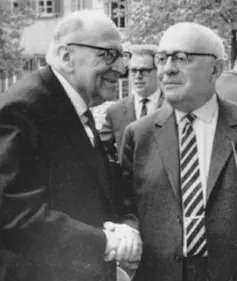
Max Horkheimer (L) and Theodor Adorno (R) in 1964.
Jeremy J. Shapiro, by means of Wikimedia Commons, CC BY-SA
Tradition occupies a central position on this image. Probably the most important tendencies of the postwar technology, Woods posits, used to be the dramatic enlargement of the class of tradition itself: as complicated international locations shifted clear of business manufacturing, “culture burst into the foreground of day-to-day life”.
The effects have been profound. Mass media started, in Woods’ phrases, “to exert tremendous power and influence over the rhythms of everyday life”. Questions of id, early life tradition and way of life got a political heft that they had no longer in the past possessed. A corresponding “cultural turn” reshaped highbrow existence, spurring scholarly inquiry into the manufacturing and move of which means.
The lengthy Nineteen Sixties
It’s in contrast surroundings that the cultural Marxism conspiracy idea will have to be understood, deriving because it does from right-wing “efforts to resist and reverse the social changes that started to unfold in the long and global 1960s”.
Relatively than treating those phenomena as ancient tendencies, the speculation’s proponents wove them right into a narrative of ideological takeover. The Frankfurt Faculty changed into a handy scapegoat in a miles higher tale about cultural exchange and the perceived decline of the postwar order.
Woods’ account strikes chronologically. The primary chapters take us again, slightly actually, to Marcuse and his heckler in Rome. The point of interest here’s at the enlargement of upper training and the fragmentation of the New Left within the latter a part of the Nineteen Sixties.
One determine looms particularly massive on this phase of the e-book. American political activist Lyndon LaRouche began out at the radical left sooner than setting up a cultish motion of his personal. Woods presentations how LaRouche and his paranoiac band of fellow travellers regularly remodeled the Frankfurt Faculty right into a handy cause of the social and cultural tendencies they deplored, in addition to for their very own failure to succeed in anything else approximating political affect.

Lyndon LaRouche in Would possibly 2004.
Mike Wintroath/AAP
LaRouche’s assaults served a political objective. By means of the Seventies, thinkers reminiscent of Adorno and Horkheimer have been being blamed for the whole lot from converting sexual mores to the upward thrust of rock tune. For somebody even remotely aware of the writings of the Frankfurt Faculty, the irony is jaw-dropping. Adorno, specifically, spent a lot of his profession castigating pop culture, which he thought to be a automobile for standardisation and social keep an eye on.
In LaRouche’s model of occasions, despite the fact that, Adorno changed into one of popular culture’s primary architects. The purpose isn’t that LaRouche were given the Frankfurt Faculty improper, despite the fact that he clearly did. It’s extra that he helped forge a story that others would due to this fact refine and lift into the political mainstream.
We see this procedure at paintings within the e-book’s 2d bankruptcy. LaRouche established the fundamental contours of the speculation, however paleoconservative William S. Lind equipped the language wherein it might succeed in wider move.
An American think-tank strategist and activist yoked to the New Proper, Lind coined the time period “cultural Marxism” in 1994, in a co-authored magazine article printed by way of america Marine Corps. The essay, Woods attests, used to be conspicuously quick on element when it got here to explaining who used to be accountable for translating “Marxism from economic into social and social terms”.
This modified a yr later. In 1995, Lind recognized the Frankfurt Faculty because the lacking hyperlink. In a brand new twist, he charged its individuals with being the motive force at the back of political correctness, a blight that used to be stymieing freedom of speech throughout The us. The imaginative and prescient Lind depicted used to be bleak. Political correctness, he claimed, used to be remodeling the rustic right into a totalitarian state.
Universities stood on the centre of this ominous worldview. As soon as hallowed websites of upper finding out, that they had now, allegedly, turn into incubators for a brand new ideological orthodoxy. The wrongdoer, Lind contended, used to be Important Principle. Evolved by way of Frankfurt Faculty intellectuals thru a fusion of Marxism, Freudianism and linguistics, it had, he charged, grew to become the USA right into a society ruled by way of “radical egalitarianism”: a rustic the place conventional values may well be undermined and ideological conformity counseled.
Lind insisted that it used to be no longer sufficient simply to warn other folks in regards to the scourge of cultural Marxism. Involved conservatives, he reasoned, had to interact in instructional activism with a purpose to reveal this risk to kin, pals and neighbours. The idea needed to be popularised.

Protestor at a Tea Celebration rally in Albany, NY (April 15, 2009).
Mike Groll/AAP
Conjunctural intellectuals
Woods’ 3rd bankruptcy examines what took place subsequent. The upward push of the Tea Celebration in 2007 equipped a great surroundings for the dissemination of cultural Marxism narratives. A decentralised political motion sustained by way of inchoate rage, on-line blogs, social media and legacy media shops, the Tea Celebration fostered the emergence of what Woods calls “conjunctural intellectuals” – self-appointed patriots who used rising virtual platforms to mobilise supporters and unfold concepts, without reference to whether or not they have been true or false.
Tea Celebration activists weren’t passive shoppers of political knowledge, however lively contributors in its dissemination. On this choice knowledge ecoystem, tales about cultural Marxism – continuously refracted despite the fact that attacks on multiculturalism and social justice problems – discovered a receptive target audience and a strong new approach of distribution.
The overall bankruptcy of The Cultural Marxism Conspiracy brings the tale into the prevailing. The political upheavals of the 2010s and 2020s provided the conspiratorially-minded with a recent set of enemies. Woods strains how older anti-Frankfurt Faculty narratives have been repackaged thru campaigns waged in opposition to Important Race Principle, “gender ideology” and, in the end, “wokeness”.
The Black Lives Topic protests supply a very powerful backdrop right here. Woods outlines how conservative activists and establishments reframed debates about racism and structural inequality during the language of ideological seize, with Important Race Principle turning into a specifically potent goal.
Donald Trump’s advert nauseam assaults on “left-wing indoctrination”, the 1776 Fee and the Highbrow Darkish Internet all function prominently within the concluding pages of the e-book.
Woods refuses readers of a left-wing persuasion simple comfort. The Cultural Marxism Conspiracy does no longer indulge the comforting fiction that those tendencies will also be defined away by way of incorrect information or manipulation, insisting that the shortcomings of the political left play a task in all of this.
However, the e-book eschews fatalism. The present second, Woods writes, is a “terrain on which we are forced to organise and act”. If there’s a notice of hope on this differently sobering tract, it lies within the insistence that political results stay contingent reasonably than predetermined. As Woods reminds us, the maze wherein we’re reputedly caught might include many false exits, however there’s a manner thru.


