



Governments, firms and different establishments will have to all play positive roles in mitigating the affects of local weather exchange. Universities, too, can and will have to assist with that effort.
We’re founded at Royal Roads College within the south of Vancouver Island, a area that represents how communities wish to plan for local weather dangers each large and small. This summer season, El Niño method hotter seas and drier prerequisites. In June, early melting intended the island had already reached 0 in keeping with cent snowpack reserve.
The Canadian executive’s drought evaluate displays above-normal temperatures and decrease precipitation around the Pacific Northwest this El Niño season. An early-season drought — which might have an effect on Vancouver Island — will negatively affect farms, wetlands, wildfire dangers and water call for from seasonal tourism. Upper temperatures, tinder-dry forests and already scarce water provides are a deadly aggregate.
Given the ones local weather realities, essentially the most a success, influential and forward-thinking universities received’t be measuring excellence the use of standing ratings and H-factors. As an alternative, they are going to display their worth via community-based metrics: without delay and constantly making use of their experience to assist native communities handle the dangers they face.
This implies an intentional, place-based option to analysis and instructing that’s arranged round a area’s distinctive and explicit issues — its other folks, histories, economies, dangers and alternatives. At a place-based or community-embedded college, excellence comes by the use of a whole-institutional means that is going past rhetoric to significant motion.
Threats to coastal communities
A person walks previous a space deserted after it was once inundated by means of water because of the emerging sea stage in Sidogemah, Central Java, Indonesia, in November 2021.
(AP Photograph/Dita Alangkara)
Coastal areas have distinct social and ecological traits formed by means of their proximity to water, restricted land and powerful native attachments. Coastal communities are regularly deeply dependent at the flora and fauna. Economies will also be tightly tied to fisheries, agriculture, ports and tourism.
However the dangers also are very actual: intensifying storms, sea stage upward thrust, flooding, warmth, in addition to drought injury to coastal infrastructure, ingesting water safety, marine ecosystems and crucial services and products.
Even with out El Niño, Vancouver Island’s new common method dry summers that rigidity and weaken huge bushes. Then wintry weather windstorms deliver the ones bushes down, every now and then knocking out energy strains, regularly for days, and blocking off roads.
In the meantime, crucial services and products — delivery, power, water, waste leadership, well being care, emergency reaction and meals provide — rely on fragile lifelines similar to underwater cables, small water or waste remedy vegetation or ferries. Those self same wintry weather windstorms disrupt ferries connecting Vancouver Island to the mainland. If the ferries aren’t operating, that in an instant affects Vancouver Island’s meals provide.
The South Island Prosperity Partnership discovered that “more than 80 per cent of our food com[es] from off-Island, only 20 to 30 per cent of our farmable land [is] in production, and only three days of fresh food [is] available at any given time.”
We additionally know that southern Vancouver Island has a couple of and overlapping vulnerabilities. Intense inhabitants pressures, compounded by means of local weather dangers and by means of the opportunity of a significant earthquake and tsunami. The ones dangers heighten the possibility of social discord as concern of shedding houses, livelihoods or beloved landscapes grows, so can also inequity, mistrust, scapegoating and injustice. The urgency could be very actual for us.
What universities can do
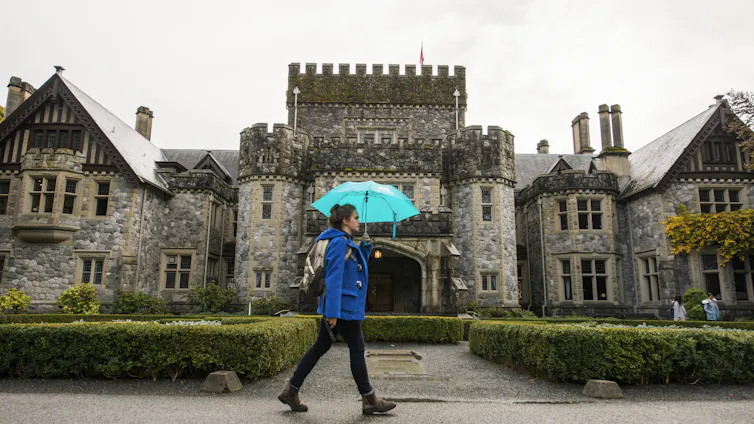
Hatley Citadel at the Royal Roads College campus in Colwood, close to Victoria, British Columbia. Universities can incorporate much more experiential finding out and network mission alternatives of their lessons.
(Royal Roads College), Writer supplied (no reuse)
All universities must be enforcing a place-based means that without delay is helping their network. However what does this imply within the day by day of college serve as?
At Royal Roads, we acknowledge that we received’t have all of the solutions. However we will use interdisciplinary gear to investigate and assess network wishes, dangers, strengths and vulnerabilities.
This implies encouraging our school, scholars and group of workers to spot what’s already operating in our network and assist reinforce productive, problem-focused partnerships with faculty forums, municipalities, network teams and the personal sector.
As educators, we will intentionally incorporate much more experiential finding out and network mission alternatives in our lessons. As an example, scholars in tourism, communications, industry or environmental science can spouse with native communities to finish solution-focused initiatives throughout various coastal landscapes.
Scholars in well being, management, crisis and emergency leadership techniques can assist design pre- and post-management situations for wildfires and earthquakes with network professionals and organizers.
We will spouse with Canada’s japanese and northerly coastal universities to expand joint, interdisciplinary coastal science levels. Those joint techniques linking coastal universities would increase scholars’ alternatives and prolong our to be had experience, datasets and network affect.
Alternatively, universities aren’t restricted to undergraduate or graduate level choices. We will additionally function hyper-regional hubs via proceeding schooling to attach researchers and carried out experience in science, well being, tradition and coverage to communities’ demanding situations.
Proceeding schooling could make that occur by means of offering a centralized finding out infrastructure: connecting the wishes of employers, non-governmental organizations and municipalities with curriculum to extra successfully ship coaching this is explicit to the network’s wishes.
The tactics universities can assist get ready our communities are considerable, however the time we now have isn’t. This summer season’s El Niño is just the start: it’s time for Canada’s universities to reconsider our priorities, spouse with like-minded establishments and get transferring.


